


Beyond Rubble: War as a Social Event
When analysts speak of the war in Gaza, they typically reach for the measurable: the tonnage of ordnance dropped, kilometers of territory occupied, percentage of buildings rendered uninhabitable. These metrics are not wrong, but they are radically insufficient – and worse, misleading.
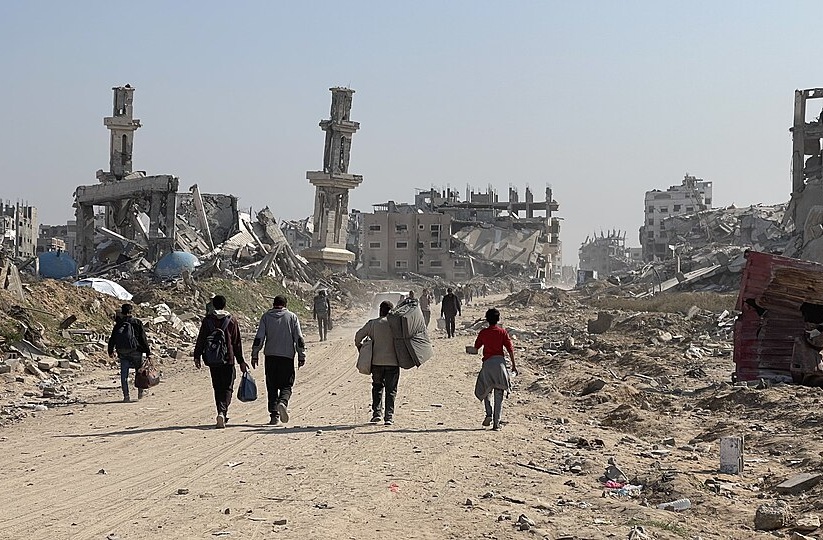
What is unfolding in Gaza is not only a military campaign. It is a civilizational rupture — a sustained assault on the shared norms around which collective life organizes itself: trust between neighbors, the legitimacy of institutions. These structures, invisible and far harder to rebuild, are now in an advanced state of collapse.
The Human Dimensions: Displacement, Starvation, Humiliation
The war’s assault on human dignity has operated through three overlapping mechanisms. The first is displacement: evacuation orders issued in rapid succession and with little warning have forced the population into an ever-shrinking corridor. Families who left their homes believing the absence would last days are now entering their second year of internal exile.
The second mechanism is hunger. During the period when the so-called Gaza Humanitarian Foundation (GHF) operated distribution corridors, it turned hunger into lethal competition. Some were trampled by desperate crowds, others were simply shot. That hunger was inherent to the war, the result of deliberate restrictions on the entry of food, fuel, and medical supplies that do not require a single deliberate act of malice.
The third mechanism, perhaps the least discussed and the most psychologically corrosive, is humiliation. The experience of being displaced by order, or of queuing for food distributed by strangers, strikes at the core of human dignity. In societies where honor, family role, and community standing are central to identity, humiliation is not a secondary harm but a primary wound.
The distribution of basic food was accompanied by lethal violence. This was a scene from a society under extreme stress, albeit one still organized around survival
The Great Exodus and the New Mediator Class
Alongside the internal displacement, a smaller but socially decisive movement occurred. Roughly 120,000 people left the Gaza Strip entirely.
Who could afford to leave? Exit required approximately USD 5,000 per person, in a territory where the prewar median income was a fraction of that. Thus, those who left were business owners, professionals, property holders, and the families of those with savings or diaspora connections: the socioeconomic backbone of the territory’s prewar – and postwar – order.
Their departure created a structural vacuum. The business community is gone. A vacuum of this kind is necessarily filled by whoever is most audacious, most willing to operate in conditions of total institutional breakdown, and most unburdened by moral constraints.
The New Operators: From Solidarity to Extraction
In the early months of the war, a new class of intermediaries emerged. Operating primarily through online fundraising platforms, individuals — often young, often with social media presence — began soliciting donations from the diaspora and international donors.
The transition from solidarity to extraction was gradual and almost imperceptible. As the months passed, field reports began to document a pattern: while some fundraising initiatives actually benefitted families in Gaza, some funds served individual enrichment. And it showed. In a territory where a liter of fuel costs ten dollars, the appearance of SUVs worth on Gaza’s damaged streets became emblematic of the growing corruption.
This is not a story about individual moral failures, though there is little shortage of those. It is a story about what happens to social behavior when every external check and balance is removed: when courts do not function, when police have dissolved, when community elders have been displaced or killed, when rules no longer apply. Émile Durkheim called it anomie — the collapse of the shared rules that make social cooperation possible. Gaza today is a textbook case.
The Corruption of Aid: When Food Becomes Power
The contrast between two scenes captures Gaza’s social transformation. During the period of GHF operations, the distribution of basic food was accompanied by lethal violence. This was a scene from a society under extreme stress, albeit one still organized around survival.
The scene field observers now report is different. Food is being discarded. This does not mean the food crisis is over. It means the distribution of food has become a tool of power rather than a mechanism of survival.
Now there are many food providers, as this is the way to solicit money. Food is delivered to the tents and people do not have to fight for it. While still scarce in many areas, it is excessive in others. This paradox reveals the corruption: when aid can be withheld, redirected, or sold, it becomes a currency in an economy of coercion. In such a system, waste is a form of social display, a signal of abundance and dominance.
This too is inherent to the postwar logic, the predictable consequence of distributing resources in the absence of accountable institutions.
Monopoly as Policy
Israel’s determination of permissible goods is instructive. For certain categories of merchandise — solar energy systems being a notable example — an import permit is granted not to a competitive market of suppliers, but to a single individual or a tightly restricted group. The result is a structural monopoly, due not to market failure but to administrative fiat. A single importer controls supply, sets prices, and captures the economic surplus generated by the desperate need for electricity in a territory with no functioning grid.
On March 11, 2026, the Gaza Chamber of Commerce and Industry — a conservative institution with no incentive for exaggeration — issued a public statement directly addressing this issue, providing formal corroboration for what field reports had been suggesting for months.
“The Chamber reaffirms its rejection of the mechanism that restricts importing goods to a limited number of traders, alongside a restricted number of suppliers on the Israeli side, while banning the import of West Bank products or goods from abroad — a situation that undermines free commerce and destroys fair competition in the markets.” — Gaza Chamber of Commerce and Industry, Press Statement, March 11, 2026.
Whatever the intent behind the Israeli licensing regime — security screening, administrative convenience, or simply profit — the effect is obvious. It has created new postwar lords in a territory bereft of a middle class
The Chamber’s statement introduces a concept that deserves particular attention: the Arabic term آتاوات — best translated as a protection levy or royalty payment — imposed by the privileged few who hold import permits on other traders who need access to goods. The Chamber describes this as financial extortion built directly into the import mechanism:
“The Chamber categorically rejects the imposition of financial levies […] by a limited group of traders as a condition for obtaining import coordination approvals. This is unacceptable, contributing directly to monopoly conditions inside markets, driving up prices, and increasing the cost of living […].” — Gaza Chamber of Commerce and Industry, Press Statement, March 11, 2026.
Moreover, some traders with import permits have begun reselling them — treating the permit itself as a commodity. This is rent-seeking in its most naked form: the monetization of access rather than of productive activity, adding a layer of extraction to every transaction in the supply chain before a single drop of milk reaches a baby.
The Chamber makes four demands: the rejection of the current mechanism, the establishment of transparent and competitive import procedures, a call on importers to observe fair pricing, and an invitation to victims of extortion to file official complaints.
Although certainly laudable, these are the demands of an institution that has exhausted informal channels and is now appealing directly to the public. That a body as conservative as a chamber of commerce uses words like “extortion” in an official press release is itself a measure of how far the deterioration has advanced.
Whatever the intent behind the Israeli licensing regime — security screening, administrative convenience, or simply profit — the effect is obvious. It has created new postwar lords in a territory bereft of a middle class, concentrating wealth and power on the basis of connections rather than merit. This is not a market, not even a failed market. It is a corrupt aristocracy.
The Destruction of Gaza’s Social Structure
It is worth being precise about what has been lost. Prewar Gaza had a functioning social structure — unequal, constrained, perverted by the pathologies of occupation and blockade, but real. It had a reputable merchant class. It included extended family networks that distributed resources and resolved disputes. It had professional communities whose authority rested on recognized expertise. It had religious institutions that mediated social behavior. In short, it was a healthy web of interdependencies that enabled collective life.
The emergence of a new layer of actors willing to operate without the constraints of social norms, professional ethics, or community accountability has not added a new element to this structure, but undermined it. When the social contract is violated with impunity, and when violation is visibly rewarded, the incentive structure facing everyone else changes. The honest merchant loses to the permit holder. The community organizer loses to the fundraiser. The professional loses to the opportunist.
The Gaza Chamber’s statement makes this dynamic explicit in economic terms: the extortion levies and permit-flipping it documents are not simply illegal. They signal to all that the rules of commerce no longer apply and that the only operative logic is proximity to power.
When an establishment institution formally acknowledges it cannot protect its members from extortion and can only invite them to file complaints, the social contract of commercial life has effectively been suspended, with consequences that will outlast any ceasefire.
The humanitarian operations are geared to refugee camp conditions. This means that families who abandon a damaged apartment for a tent can access more assistance
Housing and Hunger
The physical conditions in Gaza are themselves a force reshaping social relations. Approximately 900,000 people now live in tents. A comparable number inhabit the ruins of their own homes. Together, they are crowded into forty percent of the territory’s prewar habitable space.
Within this landscape, a remarkable economic distortion has taken hold. The monthly rent for a modest dwelling in Gaza has risen from a prewar average of below 200 dollars per month to approximately 1000 — in a territory with no functioning economy and no regular income for the vast majority of residents.
This is exacerbated by the fact that whatever aid reaches the territory prioritizes tent settlements, as the humanitarian operations are geared to refugee camp conditions. This means that families who abandon a damaged apartment for a tent can access more assistance. Indeed, many lease their homes to wealthier renters at the inflated rate and move into tents.
In this manner, a humanitarian delivery system designed to help the most vulnerable has inadvertently created the conditions for a rental extractive economy in which the remnants of the propertied class profit from hunger.
How to Reconstruct What Cannot Be Rebuilt
The question of how Gaza will emerge from this condition is one that no honest analyst can answer with confidence. The unprecedented physical destruction is actually the more tractable problem. Social and moral reconstruction presents a difficulty of an entirely different order of magnitude.
What is required is not restoration of the prewar order, itself the product of a siege economy and political fragmentation. What is required is something more ambitious and more uncertain: the reconstitution of legitimate social institutions capable of enforcing shared norms, distributing resources with accountability, and providing the conditions under which trust can be rebuilt.
his cannot be imposed from outside, and it cannot be achieved by any declaration. It is the work of a community that is currently nonexistent.
Several things appear necessary, even if none is sufficient. The first is the physical return of Gaza’s displaced population. A territory whose educated, professional, and mercantile class remains in exile cannot rebuild itself. Incentives for return, combined with genuine security guarantees, are therefore necessary.
Equally necessary is an immediate reform of the import regime. The Gaza Chamber of Commerce’s March 2026 statement provides a ready-made policy agenda: the introduction of transparent, competitive procedures; the opening of supply to West Bank and international sources; the dismantling of permit-based monopolies; and the creation of a formal complaints mechanism.
These are not radical demands, but minimum conditions. Their implementation would not restore Gaza’s economy, but their absence will prevent recovery.
Rebuilding that society will require analysts, policymakers, and humanitarians to take the social dimensions of the catastrophe as seriously as they take the physical ones
The re-establishment of institutional accountability in aid distribution is equally urgent. The corruption that has taken root is not simply a moral problem. It is a structural one that will persist and deepen without deliberate countermeasures: transparent distribution mechanisms, community oversight, and consequences for noncompliance.
The humanitarian community has tools developed in other post-conflict settings, but their deployment requires security conditions and political will that do not yet exist in Gaza.
Finally, and perhaps most challenging, the communities of Gaza need spaces — literal and figurative — in which the social norms that govern collective life can be renegotiated and reaffirmed. The war has destroyed the shared understanding of what is permissible and what is shameful. The reconstruction of that understanding cannot be scheduled or funded. It can only happen through the cumulative weight of daily interactions, of visible consequences for behavior, of leadership that models rather than exploits. It is slow work, and it requires stability.
Conclusion: Taking the Social Seriously
The destruction of Gaza’s socioeconomic structures deserves to be understood as a catastrophe in its own right. The displacement of the professional and mercantile class, the entrenchment of a new extractive layer, the corruption of humanitarian systems, the compression of nearly two million people into a tiny enclave, and finally, the collapse of shared social norms are not peripheral consequences. Combined, they spell the end of society.
The Gaza Chamber of Commerce’s statement is a significant document. It demonstrates that institutional consciousness of these processes exists within Gaza — that the people most directly affected understand what is happening and attempt to resist it through legitimate channels. That such resistance is at all possible is far from self-evident. It is, in fact, the thin thread on which any recovery depends.
To start with, rebuilding that society will require analysts, policymakers, and humanitarians to take the social dimensions of the catastrophe as seriously as they take the physical ones. A reconstruction plan that rebuilds apartment blocks while ignoring the conditions of trust, accountability, and legitimacy that make them places people want to inhabit is not a reconstruction plan. It is a construction project in a social void.
At present, living conditions in Gaza are inconducive to recovery, and the opportunity offered by the Chamber may be transient. The urgency is social as much as it is material. The international community and the parties to this conflict will do well to understand that before the narrow window for recovery finally closes.


