


The water supply in the Gaza Strip relies almost entirely on the shallow coastal aquifer. Extending along the coasts of Israel, Gaza, and Egypt, this aquifer is vulnerable to intrusion by seawater as well as to contamination by agricultural fertilizers and untreated urban wastewater.
For decades, especially since the 1990s, overextraction of the aquifer at rates more than three times its natural recharge has led to saltwater and pollutant seepage into Gaza’s drinking water reserves. Already in the early 2000s, UN agencies warned that the aquifer was on the verge of collapse.
The decline in groundwater quality in Gaza’s coastal aquifer has been gradual, accelerating in recent decades. In the 1990s and early 2000s, water quality was still acceptable, though penetration of saltwater from the Mediterranean had already begun.
In recent decades, however, more than 90% of wells show chloride and nitrate levels far above World Health Organization (WHO) recommendations, and according to the latest data, 96% of the water is unfit for drinking or even irrigation.
Since Hamas took control of the Gaza Strip in 2007, the organization’s governing priorities have favored investment in military infrastructure over water, sewage, and electricity. Goods such as pipes, cement, and steel intended for civilian construction were diverted for military uses, further eroding international donors’ trust.
In addition, Israel restricted the transfer of “dual-use” materials – those with both civilian and military applications. Political instability, prolonged blockades, and repeated cycles of conflict with Israel have undermined every attempt at consistent rehabilitation of the water and sewage infrastructure.
Most of the 65 pumping stations and wastewater treatment facilities were completely shut down, causing sewage to flood the streets and drastically reducing water supply
From Bad to Worse
This deterioration in water quality and availability has had significant public health consequences. Use of saline and contaminated water has caused increases in intestinal diseases, dehydration in children, kidney problems, and nitrate exposure. Contamination is especially dangerous for infants, leading to cyanosis, or “blue baby syndrome,” in which oxygen uptake is impaired.
Moreover, the discharge of about 100,000 cubic meters of untreated sewage into the sea each day not only pollutes Gaza’s coastal environment but also affects public health in Israel and Egypt via the Mediterranean. For example, in 2022, a pumping station malfunction in Beit Lahia caused raw sewage to flow into the sea, severely polluting Israel’s Zikim beach.
The fighting in Gaza over the past two years has dramatically worsened the situation. In the first weeks of the conflict, Gaza’s water sector was already in severe distress. The Khan Younis desalination plant was damaged beyond repair: most of the 65 pumping stations and wastewater treatment facilities were completely shut down, causing sewage to flood the streets and drastically reducing water supply.
The population became dependent on water deliveries from Israel to the southern Gaza Strip – only 3–5 liters per person per day, far below the WHO’s minimum standard of 15. Supply remains irregular, often forcing residents to buy water at high prices.
Proper wastewater treatment is essential to prevent disease outbreaks, reduce groundwater contamination, and convert a nuisance into a resource
Beyond public health in Gaza and Israel, the water crisis also has agricultural consequences. High salt concentrations in most Gaza wells make irrigation extremely difficult. Irrigation with saline water causes salt stress in plant roots, damaging vegetables, legumes, and fruit trees (e.g., chickpeas, tomatoes, cucumbers, and citrus).
Over time, saline irrigation leads to soil salinization and declining agricultural productivity. Even moderately saline water allows only salt-tolerant crops (e.g., barley), and even these may suffer yield losses.
Since the war has also reduced food imports, local production of fresh fruits and vegetables is crucial. Historically, Gaza has exported cucumbers, lettuce, tomatoes, zucchini, and peppers to Israel, making agriculture an economic lifeline. Damage to farmland thus has long-term implications for Gaza’s economy.
Water as a Foundation for Growth and Regional Stability
Without safe and reliable water, there can be no progress in health, education, or economic development. Water is therefore not only a humanitarian issue but also a prerequisite for regional stability. Any plan for Gaza’s reconstruction must include:
• Regional desalination facilities capable of supplying water to Gaza’s population. To meet even basic municipal needs, about 103 million cubic meters of freshwater per year are required. Operating these plants requires significant amounts of electricity, meaning the water solution must also address Gaza’s energy sector, whether through local power plants or electricity imports from Israel or Egypt. Large-scale desalination will also reduce overextraction of the aquifer and slow seawater intrusion into this shared resource.
• Wastewater treatment and reuse for agriculture: Proper wastewater treatment is essential to prevent disease outbreaks, reduce groundwater contamination, and convert a nuisance into a resource. Tertiary-treated water can safely irrigate vegetables and fruits, even above sensitive areas such as the coastal aquifer, supporting both local consumption and exports.
• Rehabilitation of distribution networks under strict international supervision to prevent Hamas from diverting construction materials to military use. International oversight could reduce Israeli opposition to rebuilding infrastructure while ensuring materials are not repurposed for military use.
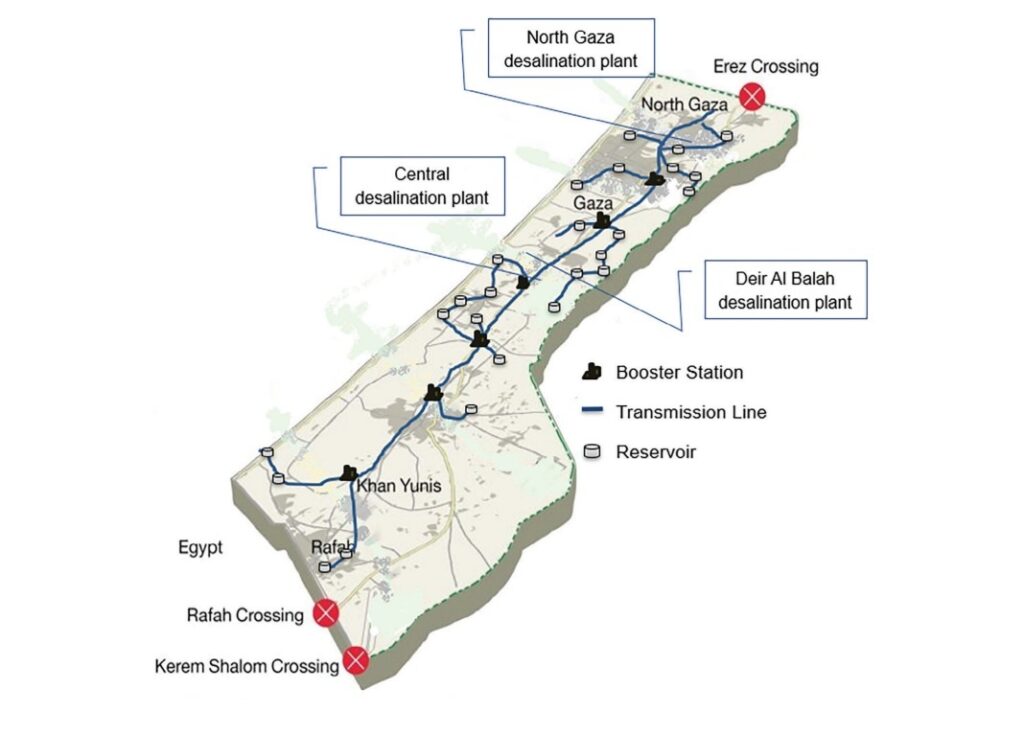
The figure below illustrates the proposed locations of future desalination facilities, pumping stations for boosting pressure in the transmission networks, and the water conveyance networks across the Gaza Strip. It is credited to PMC article, GITIS et al., 2024 – with permission from Prof. Vitaly Gitis, Ben-Gurion University.
Towards the Future
If Gaza’s leadership prioritizes civilian needs over confrontation, and if Israel permits the entry of essential materials, within eight to ten years, the Gaza Strip could achieve a sustainable water system based on desalination, recycling, and climate-adapted agriculture.
Without such change, and without a long-term ceasefire ensuring stability, international or regional actors are unlikely to invest billions in infrastructure only to see it destroyed yet again.
Israel has clear interests in supporting desalination and wastewater treatment in Gaza: reducing Gaza’s dependence on Israel, decreasing pollution of the Mediterranean, protecting the shared coastal aquifer, encouraging wealthy Arab states to invest in Gaza’s recovery, weakening Hamas’s conflict paradigm, and improving Israel’s international image as a country that supports basic living standards for its neighbors.


