


In a time full of dizzying policy U-turns, one thing remains certain: Israel’s expansionism and promotion of regional chaos.
In the past month, this was expressed in repeated strikes against Iran and Lebanon. Since the ceasefire in Iran on April 5, Israel has intensified its attacks in Lebanon. April 8 saw the biggest wave of airstrikes in Beirut since the beginning of the war. In 10 minutes, dozens of residential buildings supposedly housing Hezbollah targets and personnel were bombed, killing more than 350 people, including women, children and the elderly.
The IDF called the attack Operation Eternal Darkness; a shorter variation was adopted in Lebanese and regional media: “Black Wednesday”.
The attack had two clear and contradictory outcomes. First, the support base for Hezbollah was consolidated, as it was seen as the only force capable of countering the attacks, and Iran threatened to break the ceasefire if Lebanon were excluded (but has not done so yet). Second, the Lebanese government decided it had enough of Hezbollah’s deal-breaker role and began preparing for direct negotiation with Israel on a permanent armistice.
These two paths bring Lebanon closer to an internal confrontation than ever since the inner fighting in Beirut in May 2008, or even since the end of the Lebanese Civil War. Hezbollah continues to refuse any direct negotiations with Israel, especially “under fire”. This is viewed not only as treason, but as full capitulation to its demands.
Given this position and the fact that President Aoun and Prime Minister Salam had condemned Hezbollah military actions, it is hard to see how the delicate balance of power in Lebanon could be maintained for much longer.
The war against Iran ended this ‘grace period.’ Israel has made clear it is not interested in reforming the Iranian regime but is pushing for its collapse
Over the past month, the Forum has made a special effort to map the wider mood under the shadow of war, publishing brief reviews from global and regional media to illuminate the dynamics and their long-term consequences. Two paradoxes emerge. Firstly, Israel works to completely dismantle the militias of the Axis of Resistance, while simultaneously undermining the very order that can replace them. Secondly, the militia model Israel ostensibly fights abroad is increasingly adopted back home.
Militias Abroad
One of the stated reasons for Israel’s attacks on Iran and Lebanon is its dissatisfaction with the prospect of leveraging prior military gains to strengthen state actors against the Axis of Resistance. After the previous ceasefire in Lebanon and the regime change in Syria, it appeared Israel would allow the new governments in those countries — and in Iraq — to wrestle with Iranian influence and militia presence on their own, while giving the Iranian regime space to weaken or reform from within.
A comprehensive review published by Ghazi Abu Jiab on March 9 examined the prewar trajectory of armed militias across the Middle East: Hezbollah was pushed toward partial disarmament and full demilitarization in southern Lebanon; Hamas sought international legitimacy while agreeing in principle to disarm its heavy weapons; and Iraq’s Shia militias saw the need to move toward civilian politics.
Yet in all these cases, writers questioned the depth and sincerity of these processes, and Israel’s remained highly skeptical. The war against Iran ended this “grace period.”
Israel has made clear it is not interested in reforming the Iranian regime but is pushing for its collapse. Early in the war, some observers — including On Dahan, in a March 11 piece informed by Jordanian analyst Muhammad Abu Rumman — suggested that targeted strikes against the Revolutionary Guards and the killing of Supreme Leader Ali Khamenei might lead to the rise of reformist forces capable of reaching a settlement with Washington.
Israel has ignored the Lebanese government’s efforts to demonstrate its opposition to Hezbollah, and Hezbollah has ignored the government’s attempts to keep it out of a new war
Since then, Khamenei’s son Mojtaba, identified with the hardline conservative camp and the Revolutionary Guards, was elected Supreme Leader, and negotiations were apparently led by another hardliner, parliament speaker Mohammad-Baqer Qalibaf.
In a dissenting opinion to the war enthusiasts, Itay Malakh covered a Foreign Policy article by Marc Lynch. Before the war, Lynch outlined four scenarios for its end: a pro-Western monarchy or republic, full state collapse, fragmentation, or (most likely) a weakened version of the existing regime.
Lynch argued that Israel prefers the third scenario. The UAE appears to support this Israeli position. The United States, after its failures in Iraq, Afghanistan, Libya and more, is now less willing to gamble again on anarchy, would rather have a weak but compliant regime. Thus scenario now appears to be unfolding, to the Israeli government’s evident frustration.
The same dynamic is evident in Lebanon. Israel has ignored the its government’s efforts to demonstrate its opposition to Hezbollah, and Hezbollah has ignored the government’s attempts to keep it out of a new war. The result is an invasion to southern Lebanon, with Israeli preparations for a new and expansive “security zone”.
Analyst Yezid Sayigh, reviewed by Elitzur Gluck on March 9, confirms that Israel started the military action in Lebanon seeking, probably unrealistically, to disarm Hezbollah by force and alienate it from its Shia constituency through disproportionate destruction.
Another explanation for Israel’s course of action was that it was using the campaign against Iran as cover to impose a political outcome on Lebanon involving normalization and Hezbollah’s disarmament. In practice, Israel reduces Lebanon to a state in name only, stripping it of sovereignty.
Disarmament also requires deepening the rift between Hezbollah and Amal, offering the Shia community political representation according to its demographic weight, and providing credible reconstruction incentives
Yet this approach is precisely what could squander a historic opportunity, argues Forum associate Elizabeth Tsurkov in a piece published in Israel Hayom. Tsurkov claims that Hezbollah today is more isolated and weakened than at any point in its history — militarily depleted, economically crippled since the collapse of Assad’s Syria shut down its smuggling routes, and facing unprecedented criticism even from within the Shia community.
For the first time, ordinary Shia Lebanese who have fled their homes because of Israel’s evacuation orders, issued as a disproportionate response to Hezbollah’s rocket fire, are openly condemning the organization. Even Amal, its longtime parliamentary partner, has not opposed the Lebanese government’s decision to criminalize Hezbollah’s military activity.
However, Tsurkov argues, military force alone cannot achieve disarmament. Strengthening the Lebanese state – not destroying it – is a prerequisite. Threatening the Lebanese government, as Defense Minister Katz has recently done, directly serves Hezbollah’s interests. Disarmament also requires deepening the rift between Hezbollah and Amal, offering the Shia community political representation according to its demographic weight, and providing credible reconstruction incentives.
As with Iran, without a political strategy to accompany military pressure, Israel will slide into another Lebanon war or bleed in another security zone.
Like the Gulf states, Lebanon’s US- and Israel-aligned actors find that whether or not they choose to participate in the war against Iran and its partners, they pay the entire bill. Israel may intend to dismantle the Iran-backed militias, but its refusal to allow any alternative order dooms the effort.
Militias Back Home
Israel appears to be adopting the very model it is fighting against abroad. An article by Yonatan Kanonich from the Yesh Din NGO describes the dramatic surge in Jewish settler violence against Palestinians since the outbreak of the Iran war.
Jews called up to reserve duty in rapid-response and territorial defense units in the West Bank have been granted law-enforcement authority. In practice, they are often the leading perpetrators of violence and displacement against Palestinian residents — responsible for mounting incidents of assault, property destruction, and even killing.
Weapons distributed by the state for “self-defense” are used in pursuit of ethnic cleansing. An armed force that at times does not even answer to the military chain of command is now the de facto ruler of the West Bank.
Iyad also describes the reality of the ever-changing “yellow line”, the area behind which is under IDF control. The eastern part of the strip, from the yellow line to the international border, is now a land of ruins: houses flattened, roads destroyed
Back to Gaza
Whereas Gaza has been sidelined from local media for at least a month, we still see discussions about the war’s impact on various platforms. And yet, real accounts of life in the ruins are scarce. After Smadar Ben-Natan brought the story of her friend Iyad and his family from a refugee camp in January, another part of his testimony is now offered.
Published on March 12, it is a chilling description of a tour from Deir al-Balah in the central strip through Gaza city and back. Iyad shows again how insanely different the strip is after two and a half years of war and destruction. He writes about the markets in a central square, which have become the main way to receive aid or buy basic products at obscenely high prices, using old and damaged Israeli banknotes.
Since fuel is scarce, cars now run on cooking oil. Iyad describes trying to get a new apartment for his family inside the city, but being asked to pay a monthly rent of $1000, way out of reach for the vast majority of Gazans. He tried to register his daughter to a special school, but the price was again unaffordable. The main thing Iyad could bring back to his daughters from Gaza city was qatayef, sweets for Ramadan…
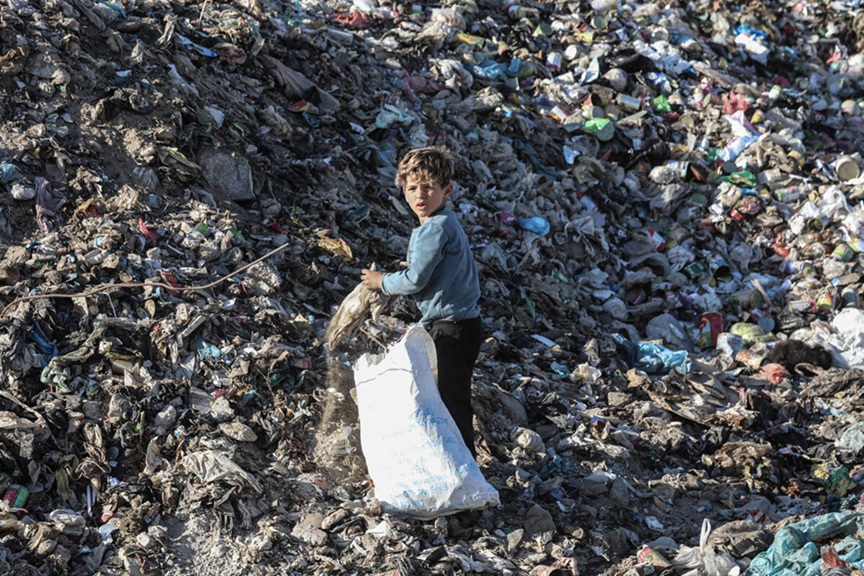
Iyad also describes the reality of the ever-changing “yellow line”, the area behind which is under IDF control. The eastern part of the strip, from the yellow line to the international border, is now a land of ruins: houses flattened, roads destroyed, and everything covered with construction waste from the demolished buildings. Places that Gazans once knew have become a post-apocalyptic landscape.
This is also shown in Leena Dallasheh and Liat Kozma’s article of March 29, depicting the pattern of systemic destruction as the expected result of all theaters of Israeli war. From Gaza to Lebanon, from Syria to Iran, mass demolition rationalized by defining every building, road or bridge as “terror infrastructure” have become rampant.
Dallasheh and Kozma also show how calls for mass destruction are now made publicly by rightwing journalists and politicians. Even opposition leaders such as Yair Lapid and Gadi Eisenkot support “scraping” villages in Lebanon and implementing the notorious “Dahiyeh Doctrine” countrywide. The results of this discourse are seen on the ground, leading to the displacement of more than a million Lebanese. It is thus becoming increasingly obvious that this chaos is not a byproduct of Israeli acts of war but their purpose.
In Tzidkiyahu’s opinion, those researchers assume IDF sources to be accurate, without any basis, while trying to refute the Gazan lists using flawed methods and cherry-picked claims
In another harrowing anecdote from Iyad’s account, he describes a young man who travelled with him to Gaza city to identify the remains of his brother. Like many other Gazans, the man’s entire family was killed in an airstrike. He was asked to identify them twice already, but now the Health Ministry asked him to return and identify his brother’s skull, because they found another man’s ID card under the rubble.
This brings us to another aspect of Israel’s Gaza discourse: minimizing the war’s casualties. In a column published by Eran Tzidkiyahu on March 24, he reviews some of the claims of Israeli researchers about “manipulations” in the list of Gazans killed in the war, maintained by the Health Ministry.
In his opinion, those researchers assume IDF sources to be accurate, without any basis, while trying to refute the Gazan lists using flawed methods and cherry-picked claims. More importantly, however, Tzidkiyahu shows how the reduction of the war discourse to minute arguments about details is in fact a diversion from the most important question: how Israeli policies of annihilation were allowed to take place.


